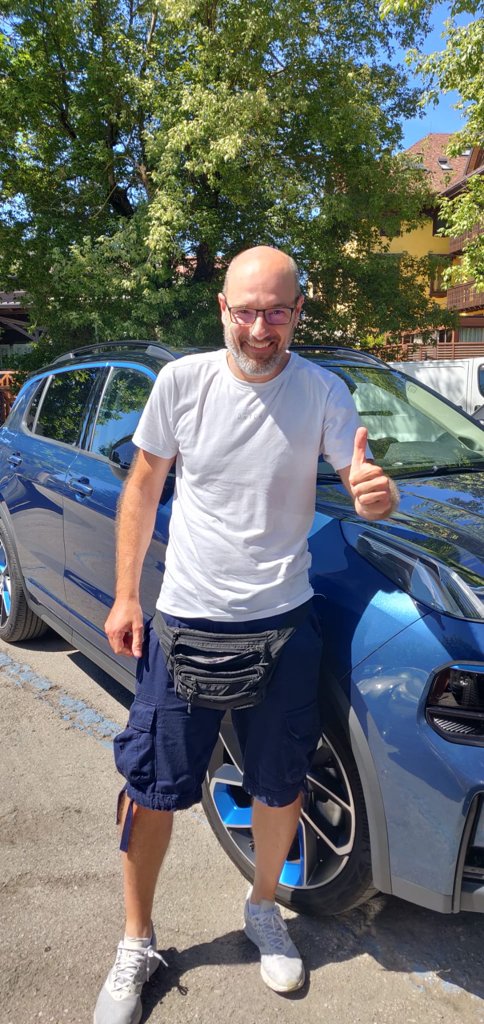
I recently had the opportunity to test drive a Lynk & Co 01. I will not say much about the car itself, which is a plug-in hybrid vehicle. There are tons of reviews on YouTube detailing its features and performance. Instead, I’d prefer to concentrate on the whole user experience as this vehicle can be used in some really innovative ways.
First of all, those who intend to use it permanently have two options:
- They can purchase it in the conventional manner (at the time of writing, the price is 44,500 euros).
- They can rent it for 600 euros per month, with no upfront payment required and the option to terminate the lease whenever they choose, much like Netflix.
But I think the sharing-related innovation element is the most intriguing. In fact, the car in turn can be rented out to other members of the Lynk & Co community for a fee. The whole process is carried out through an app and is very smooth. No direct contact with the person who is lending us the car is necessary. To sum up, this is how it works:
- You look for neighboring cars that are available. The pickup/delivery point is indicated on the map that the app displays.

- After locating one that works for us, you provide the time slot you want to rent the car.
- The app tells us how much we would go to pay (the sharing lender is free to charge whatever rate they want). To this amount, 100 euros of escrow must be added which is temporarily withdrawn and then refunded at the end of the rent.
- If the amount is fine with us, you submit the request.
- If the request is approved, the car will be ready at the time we specified and may be picked up at the place the app suggested when we selected it (see the first step).
I tried this process myself to rent a car for about 14 hours.

When you arrive at your designated pick-up location, you have to take five photos of the vehicle (front, back, left, right, and roof). These photos will be used by the company to track any damage to the vehicle that occurs during the rent. These potential damages would then be charged to the credit card of the individual who rented the car, in addition to the rental fee. After taking these photos, one can open the car using the same app. Indeed, the phone connects to the machine via Bluetooth and functions as an electronic key. Once the rental is done, the driver parks the car at the pickup/delivery location, takes the five photos as described before, and then closes the vehicle. That’s it. There are no phone calls to make, forms to sign, or wire transfers to make. When you return the car, Lynk&Co also makes adjustments in relation to the gasoline used. If the car contains more fuel than it had at the beginning of the rental, the equivalent value of the extra gasoline is deducted from the rental fee. Conversely, the fee is increased by this sum. For instance, I was charged an additional 9.02 euros, making the total amount I paid 49.02 euros.
In conclusion, the user experience was fantastic all around. It’s amazing how easily the entire picking up/returning process is handled. I don’t even talk about the driving experience. I just say that it was like traveling on a starship compared to the Citroen Nemo I own. In some ways, it was an even more satisfying experience than driving the Tesla Model S. That said, it is worthwhile to consider the sharing model developed by Lynk & Co from the environmental point of view too. I think that a radical rethinking of mobility will be a key component of the energy transition. In order to create a mix of solutions that will allow us to meet the ambitious targets we’ve set for lowering greenhouse gas emissions, mechanisms like the one I’ve illustrated in this blog may be extremely helpful.

 LLandre.com
One thought on “Is this part of future mobility?”
Comments are closed.